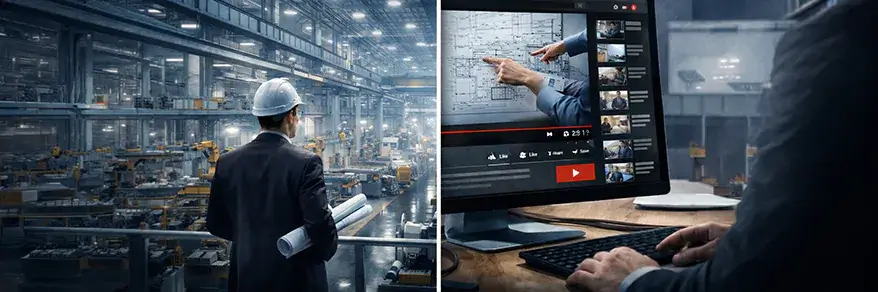
Most manufacturers are using YouTube like a filing cabinet.
Upload the installation video.
Post the product animation.
Embed it on the website.
Check the box.
Meanwhile, one of the largest attention platforms in the world — with more than 2 billion logged-in monthly users, according to Alphabet — is sitting there, underutilized.
This isn’t a marketing oversight.
It’s a strategic one.
A recent analysis in The Business of Fashion argued that consumer brands are underutilizing YouTube as a long-form world-building platform. The same — perhaps more urgently — applies to B2B manufacturing.
The Platform Everyone Uses — But Few Use Strategically
YouTube is not TikTok.
It is not Instagram.
It is not a short-form awareness channel.
It is the second-largest search engine in the world — owned by the first.
Every day, users watch over one billion hours of video globally. Increasingly, viewers consume YouTube on television screens, not just mobile devices. It is lean-back, long-form consumption.
In B2B, that matters.
Because B2B purchasing is not impulsive. It is researched. It is layered. It is cumulative.
Google’s B2B buyer research consistently shows that 70% or more of B2B buyers watch video during their purchasing process, and that video meaningfully improves understanding of complex products. Wyzowl’s Video Marketing Statistics reports regularly find that over 80% of marketers say video increases dwell time, with a majority reporting measurable improvements in lead generation and sales outcomes.
Yet manufacturers continue to treat YouTube like a storage locker.
Installation Videos Are Not Strategy
There is nothing wrong with “how-to” content.
But if that is the entirety of your presence, you are not building authority.
You are building documentation.
Authority comes from interpretation.
Authority comes from explaining:
- Why a design decision matters
- Why a common field failure happens
- What regulatory changes will impact the category
- Where misconceptions cost contractors money
- What trade-offs buyers rarely consider
Most manufacturers have this knowledge internally.
Few publish it.
That gap is strategic opportunity.
The Compounding Nature of Long-Form Authority
Short-form platforms reward speed.
YouTube rewards depth.
The customer who watches eight minutes of thoughtful analysis behaves differently from the one who scrolls past a 12-second clip.
Long-form viewers tend to become higher lifetime value customers because they are intellectually engaged and confident. In B2B, that confidence drives specification.
Specification drives revenue.
And YouTube’s search-based discovery model means content compounds over time. A well-produced technical explainer can surface years later when an engineer is evaluating options.
Trade show booths disappear after three days.
Video libraries compound.
“We Don’t Have the Budget” Is Not the Real Issue
Many manufacturers hesitate because they assume YouTube requires studio-level production.
It does not.
Production costs have fallen dramatically. Consumer-grade cameras, simple lighting setups, and in-office environments can produce more than adequate long-form educational content.
The barrier is not budget.
It is philosophical.
YouTube requires a point of view.
It requires a willingness to say:
“This is what we believe about this category.”
Many manufacturers are comfortable describing features.
Fewer are comfortable articulating philosophy.
And yet philosophy is what differentiates in commoditized markets.
World-Building in B2B Is Intellectual, Not Aesthetic
In fashion, world-building is aesthetic storytelling.
In B2B manufacturing, world-building is intellectual.
It is the ecosystem of ideas that surrounds your product:
- Your interpretation of performance standards
- Your take on future compliance shifts
- Your field experience
- Your engineering trade-offs
- Your historical perspective
When you publish consistently, you are not just promoting product.
You are curating a worldview.
Over time, that worldview attracts a specific kind of customer — one aligned with how you think.
Those customers tend to be more loyal.
YouTube as Infrastructure, Not Promotion
Because YouTube lives inside the Google ecosystem, it integrates with search visibility, paid media, and remarketing in ways many manufacturers underexploit.
A single 10-minute technical explainer can become:
- A searchable authority asset
- A training tool for reps
- A recruiting signal to engineers
- A clipped source for LinkedIn
- A paid media creative asset
YouTube’s analytics — watch time, retention curves, drop-off points — provide insight into where your messaging resonates or fails.
That is product intelligence hiding inside marketing data.
The Consistency Problem
One video does nothing.
Ten videos create familiarity.
Fifty videos establish authority.
The manufacturers who win on YouTube will not be the most viral.
They will be the most consistent.
A predictable cadence signals seriousness.
An abandoned channel signals experimentation.
In B2B, seriousness matters.
A Personal Proof Point
I have built a growing audience around Reading with Jimmy — a literature platform — without a corporate media department or entertainment budget. The milestone of 100 subscribers was not driven by scale. It was driven by consistency and clarity of thought.
Manufacturers possess exponentially more intellectual capital than a literature channel ever could.
If an independent educational platform can build traction through disciplined long-form publishing, manufacturers can do the same.
The difference is not resources.
It is intent.
The Strategic Question
In a market where product differences narrow and price pressure intensifies, what separates you?
If your differentiation lives only in the spec sheet, you are competing on physics.
If your differentiation lives in your thinking, you are competing on philosophy.
YouTube rewards philosophy.
Manufacturers that continue treating it as a video archive will remain interchangeable.
Manufacturers that treat it as infrastructure will quietly build cumulative advantage while competitors are still uploading installation clips and calling it strategy.
Good instinct. A short methodology note signals discipline. It says: this is strategic commentary grounded in structured review, not opinion dressed up as data.
Here is a concise version aligned with your reporting tone.
Methodology Note
This analysis synthesizes publicly available corporate disclosures (Alphabet Inc. Form 10-K), official reporting from Google and YouTube, and industry research from Think with Google, Wyzowl, HubSpot, and Demand Gen Report regarding video consumption behavior and B2B purchasing dynamics.
Rather than functioning as a platform usage summary, this article applies cross-industry data to identify structural patterns in attention, search behavior, and long-form engagement — and evaluates their strategic implications for industrial and manufacturing brands.
All quantitative references reflect the most recent published materials available at the time of writing. The interpretive framework and strategic conclusions presented herein represent Interline Creative Group’s independent analysis of those patterns as they relate to long-term brand positioning, authority development, and cumulative competitive advantage in B2B markets. For additional long-form video and strategic content examples, visit Interline’s Media Room. https://interlinegroup.com/media/