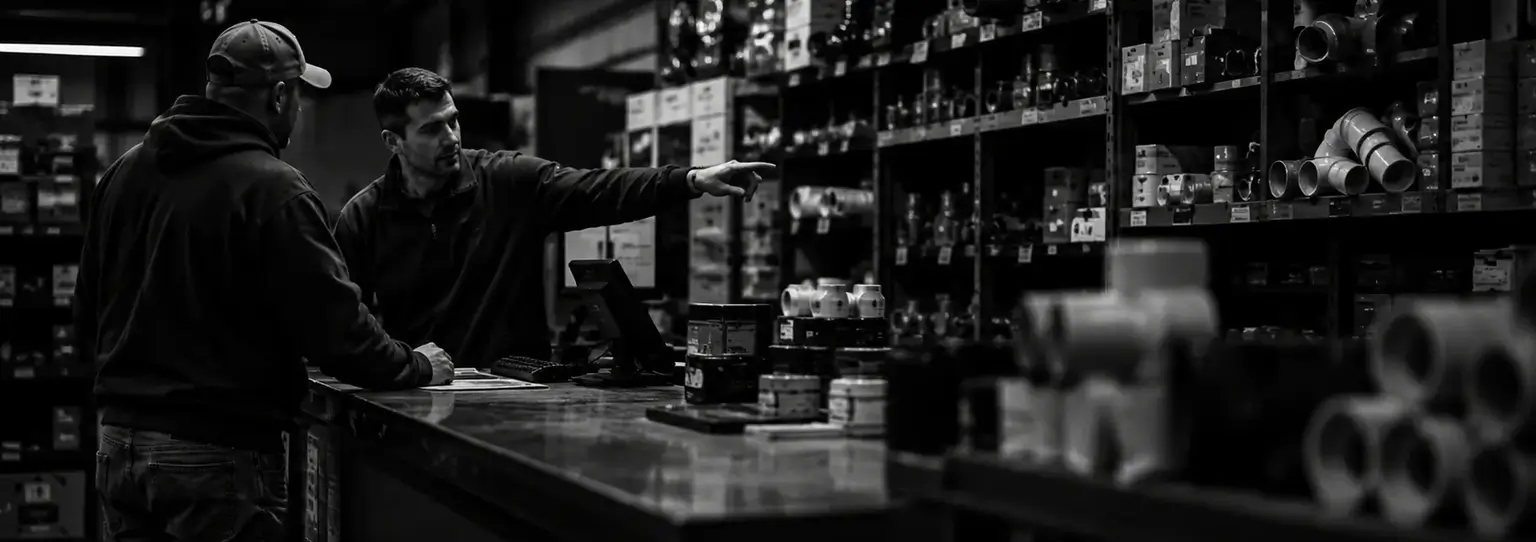
What luxury retail’s real estate reckoning tells building products manufacturers about channel strategy.
Luxury brands are closing stores. Not because retail is dying, but because they finally admitted something the data had been telling them for years: a mediocre location with a distracted staff produced worse returns than no location at all. The solution was fewer stores, better positioned, with more investment concentrated in each one.
Gucci closed a net 75 stores last year and is planning to close roughly 100 more. Ferragamo is shutting 70 locations while opening about half that number in stronger markets. New luxury store openings hit their lowest level since 2020, with more than half concentrated in around 30 so-called alpha cities.1
The parallel to B2B distribution is obvious. But the lesson most manufacturers draw from it is wrong.
The Wrong Lesson
The instinct is to read the luxury story as a loyalty argument. Pick your best distributor in each market. Invest deeply in that relationship. Turn them into a brand advocate.
That instinct has been driving channel strategy in building products, HVAC, and plumbing for thirty years. It has never worked, for a straightforward reason: a distributor’s value proposition to the contractor buying from him is choice. He carries multiple lines because that’s what his customers need. The moment he becomes a true brand advocate for one manufacturer, he’s working against his own reason for existing.
Distributors have always had anchor brands—the line that anchors the assortment the way a department store anchor tenant organizes a mall. But the anchor relationship is sustained by volume and margin, not loyalty. Change those economics and the anchor shifts. That’s not a trust problem. That’s the model working as specified.
Relationships Are More Complicated Now
The distribution model has always carried this structural tension. What’s changed is that the tension is greater. Large distributors are no longer simply moving product from warehouse to contractor. Many are now building private-label lines, developing contractor ecosystems, and investing in digital procurement platforms that reduce their dependence on any individual manufacturer’s brand.
That makes the distributor simultaneously a channel partner and a competitive threat. A manufacturer who still thinks of the relationship primarily in terms of co-op spending and branch visits is managing the wrong problem. The distributor isn’t just indifferent to your brand—he may be actively evaluating whether to replace it.
There is also a brand environment problem that manufacturers underestimate. A premium product displayed in a chaotic branch beside private-label substitutes is not being experienced as premium. The environment changes the meaning of the product. Loyalty programs and counter incentives don’t fix that. They paper over it.
 What the Luxury Story Actually Teaches
The more useful part of the luxury reckoning isn’t the store closures. It’s the strategic shift underneath them. Brands like Gucci and Ferragamo are pulling back from wholesale and investing in directly operated stores—formats they control—because wholesale gave away too much: pricing discipline, merchandising, the in-store narrative, the customer relationship.
That’s the real question for a building products manufacturer. Not “how do I get my distributor to advocate for my brand?” but “what does my distributor actually provide that I can’t replicate or supplement through other means?”
The honest answer, in most markets: logistics and last-mile reach, contractor relationships built over years, and the absorption of credit and inventory risk. Those are real and durable advantages. They are also narrower than most manufacturer channel strategies acknowledge.
Align Incentives. Don’t Ask for Loyalty.
If the distributor’s value is logistics, relationships, and risk absorption, then the manufacturer’s job isn’t to win mindshare at the counter. It’s to make his product the easiest to specify, the easiest to sell through, and the easiest to support—so that the distributor’s self-interest and the manufacturer’s interest run in the same direction without requiring loyalty to get there.
That means cleaner ordering and fulfillment, contractor pull-through programs that reduce the distributor’s selling burden, specifications that arrive already written rather than needing to be sold from the counter, and technical support that makes the distributor look competent to his customer rather than forcing him to escalate.
It also means investing in the market directly—training academies, contractor programs, specification tools, owned educational content—not to eliminate the distributor, but to build the kind of demand that makes your line the path of least resistance for him to stock and support. The anchor brand in a distributor’s portfolio got there through demand, not relationship. The contractor asked for it. The architect specified it. The distributor stocked it because not stocking it cost him business.
That’s the position worth building toward. It’s slower and harder than a spiff program (but with a spiff, you are almost unstoppable). It’s also the only one that holds when the sales rep turns over, when a competitor offers better co-op terms, or when a new distributor contact decides to rebalance his line card—or launch his own.
The Distributor Isn’t the Market
Luxury brands spent two decades confusing wholesale reach with brand strength. The current reckoning is the correction. A Gucci store on a secondary street in a second-tier city was never building the brand. It was diluting it while creating the illusion of distribution.
A building products manufacturer with broad distribution but weak specification pull-through, poor contractor awareness, and no direct market intelligence is in the same position. The line card entry exists. The business doesn’t.
The distributor is the channel, not the market. Get the market right and the channel follows. Ignore the market long enough, and the channel finds a substitute for you.
 Channel Readiness Self-Assessment
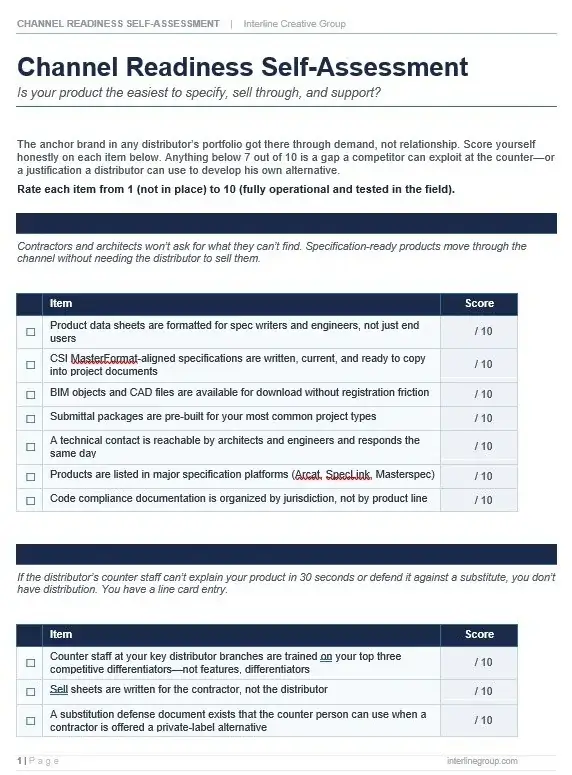
How exposed is your current channel position? We’ve built a Channel Readiness Self-Assessment around the three pillars above — easiest to specify, easiest to sell through, easiest to support. Score yourself on 21 items and see where the gaps are before a competitor or a private-label line finds them first. Email us at jim@interlinegroup.com and we’ll send it directly.
1 Eric Sylvers, “Fewer, Bigger, Better: How Luxury Brands Are Optimising Their Stores,” The Business of Fashion, May 13, 2026.