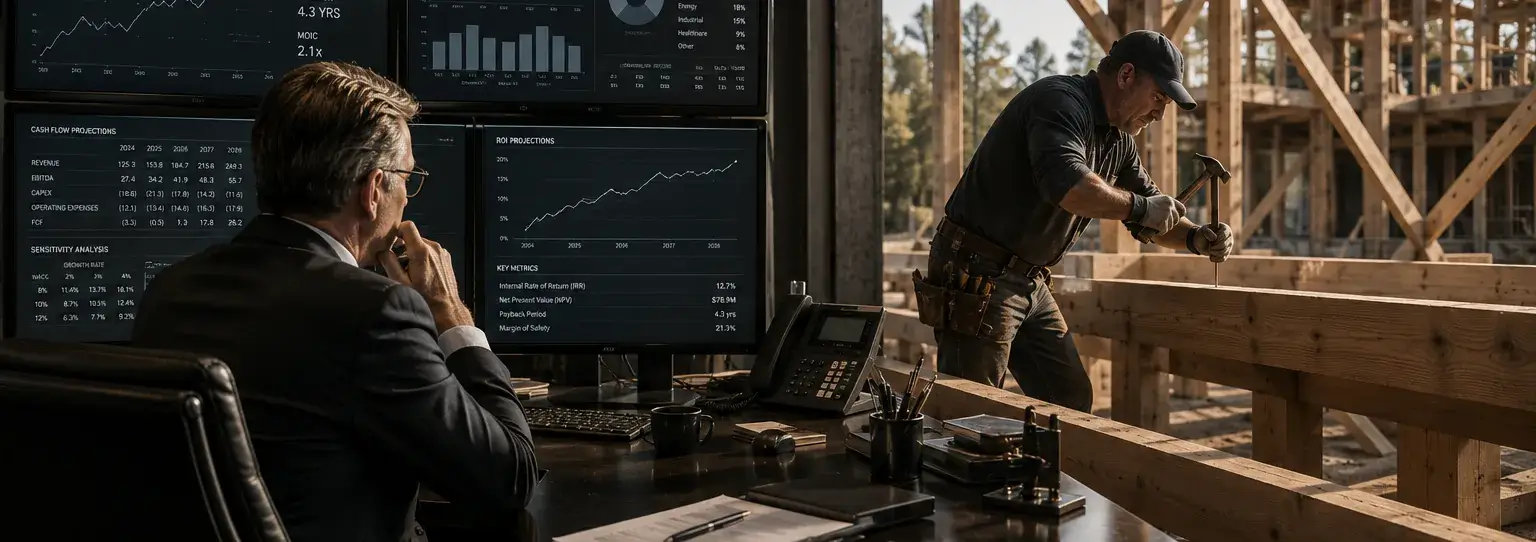
Living in a bubble has advantages and disadvantages. The advantages are that you think reality is inside the bubble. The disadvantages are that you think reality is inside the bubble.
The most recent example of this you can see in the recent Wall Street Journal article “We Went to Wall Street’s Exclusive Wilderness Camp. Everyone Was Spooked by AI.” by Hannah Erin Lang. The tell was in the second and third sentences:
“The crowd of money managers, economists and other finance types had made their annual pilgrimage to this fishing mecca in Maine’s wilderness, trading suits for T-shirts and cargo pants. As they drained their wine glasses in the wood-paneled dining room, Norton had them transfixed.”
If you have ever gone camping, wood-paneled dining rooms are rare. Søren Kierkegaard is the guy I credit for this piece of advice: “Knowledge is comparison.” And when you live in a bubble, comparison becomes impossible. And so does knowledge.
You only have to read the WSJ piece to see the bubble signs everywhere.
- One evening, a frank debate played out over a poker game.
- This lakeside resort—which some campers compare to Jackson Hole or Davos—is where attendees say things they might not otherwise write in analyst notes or shout over CNBC airwaves
- On canoes, over coffee and around the poker table, attendees (or “campers,” as they are referred to here) debated whether the earnings from the big AI spending binge will materialize or the market is headed for pain.
What attracted my attention was the spooking going on about AI.
These supposedly smart people were genuinely spooked by what’s going on with AI, especially since the question that spooked them was about “ROI.” Someone asked someone (they don’t like to use names at the camp) “Will there be a return on that investment?” The someone answered: “I can’t answer the question, and Wall Street can’t answer the question. I don’t know that yet. I worry about that.”
For a bunch of really smart people, worrying about the ROI of AI is kinda stupid, especially if you look at history. Because there is an inability to calculate ROI throughout history, especially when it comes to tools like AI; some changes have always created economic consequences long before anyone could reliably identify, attribute or measure all of them. Those changes look like technology, but they are really tools.
Consider the Internet
When the internet first began taking over everything, one question came up repeatedly to me: Who is paying for all this?
There was this enormous infrastructure growing in front of all of us, with information suddenly moving everywhere, websites appearing by the thousands, companies investing fortunes and entirely new industries forming around something whose ultimate economic model remained remarkably difficult to explain. I would imagine the same thing happened with any tech advance dating back to the printing press.
Somebody had to be paying for it. But who?
Decades later, there still isn’t a particularly satisfying answer, because in one sense everybody pays for it and everybody benefits from it, although not necessarily in equal proportions and certainly not at the same time.
The internet survived the uncertainty. More than survived. It became part of the infrastructure of civilization, despite enormous overinvestment along the way, a spectacular dot-com bubble, disappearing companies, lost fortunes and telecommunications capacity built far ahead of immediate demand.
The investors (pardon me, campers) are worrying needlessly.
Living in a bubble, they see trillions of dollars flowing into chips, data centers, power generation, infrastructure and AI companies, raising the perfectly reasonable doubt of whether all of that investment will ultimately generate an adequate return.
But only if you live in a bubble. If you go outside your bubble, you quickly see things have a way of shaking themselves out just like the other tech or non-tech tools did.
Nobody Calculated the ROI of the Hammer
Imagine being present when someone invented the hammer and, before allowing anyone to manufacture one, you go to Wilderness camp and start discussing how many hammers the market would require, what the projected five-year utilization rate might be, how many incremental houses could be directly attributed to hammer deployment and what would happen to hammer demand if interest rates increased 50 basis points.
While the campers worked on the dashboard, somebody else would probably pick up the hammer and drive a nail. That person would already know something the committee didn’t.
It worked. Or it didn’t.
The utility of the tool preceded the economic models. That is the nature of tools.
Eventually someone would make a better hammer, somebody else would manufacture nails, builders would construct things more efficiently, new construction techniques would develop, industries would form around the tool and, eventually, somebody would invent a nail gun.
The consequences would continue radiating outward until asking for the “ROI on the hammer” becomes meaningless. The hammer ceases to be a product whose value can be measured simply by the number of units sold. It becomes part of productive capacity itself. Part of us.
That is actually the way to think about artificial intelligence because AI is rapidly becoming something more consequential than an industry. Which is why those “campers” missed it living in their bubble.
AI is a tool like a hammer.
Tools don’t merely generate revenue. They alter what human beings are capable of doing. They create value.
 The Arrogance of Measurement
None of this means ROI is meaningless. Businesses have to measure things like investments, advertising, response, conversion, sales and productivity because capital is finite and choices have to be made. The list is endless, and if you start building that list, you eventually create a bubble around yourself and miss the obvious: you are working on calculations instead of doing real work.
The problem begins when the sensible proposition that we should measure what we can quietly becomes the much more arrogant proposition that what we cannot measure has no value.
A very smart electrical application engineer once told me: “If you can measure it, you can control it.” He was talking about electricity. But when I asked him, “What is electricity?” He smiled and said, “We don’t know. We just know we can control it – most of the time.”
At that point I realized it is OK not to know things like ROI right away. Sometimes the obsession with measurement becomes its own form of wasting time. It is like building an elaborate dashboard to track all the work an organization intends to accomplish and becoming so absorbed in perfecting the dashboard that nobody gets around to doing the work.
Measurement is supposed to be subordinate to actions. Actions should never be subordinate to measurements.
ROI has the same problem because every calculation contains an arbitrary limit. It’s like a photograph. A moment in time is captured, which is immediately in the past. It no longer exists. ROI calculations are photographs of a moment: the moment you figure it out, the more untrue it is.
Quantum mechanics offers an even stranger reminder of the limits of measurement: the more precisely a particle’s position is known, the less precisely its momentum can be known, and vice versa. Measurement doesn’t give us everything. Sometimes greater certainty about one thing necessarily means less certainty about another.
The world, however, does not close with the spreadsheet. Unless you live in a bubble.
The Postcard Nobody Could Properly Measure
Years ago, my client (a large electrical equipment manufacturer) had a mistake made on one of their ads by a trade magazine. As compensation, the publication offered a postcard in their deck of postcards that they mailed to their circulation.
The postcard generated an inquiry that ultimately resulted in an order for an entire electrical substation worth hundreds of thousands of dollars.
Now calculate the ROI.
Should the sale be attributed to the postcard, even though its media cost was effectively zero because it was a make-good? Should it be attributed to the original advertisement the publication had mishandled? To the creative work? To the salesperson who followed the inquiry? To the manufacturer’s reputation, which had been built over decades before the prospect ever saw the postcard?
Suppose that customer purchased another substation five years later. Does that revenue belong in the calculation?
Suppose another person received the same postcard, didn’t respond at all, but remembered the company three years later when a need arose and made a telephone call. Does that count?
At what point does the calculation stop? The answer is whenever someone decides to stop measuring. The consequences of the “investment” don’t stop.
The measurement does.
That difference explains much of what gets lost in discussions about ROI like the campers had. Qualitative consequences almost always dwarf quantitative measurements. Some effects surface immediately, others appear months or years later, and still others create consequences that can never reliably be traced back to the action that initiated them.
Actions have consequences. Measurement needs a clock. Confusing the two produces a badly distorted understanding of what those campers were really trying to determine: value.
The Internet Didn’t Create Demand for Information
The same confusion about value surrounds what happened to publishing when the internet arrived.
The internet did not destroy trade publishing because demand for information suddenly exploded. The demand was always there. Architects wanted information. Engineers wanted information. Contractors wanted information. Manufacturers wanted to communicate information to all of them.
What trade publications possessed was not demand. They possessed the path.
Before the internet, a manufacturer that wanted to reach a specialized audience usually needed a publication, and members of that audience looking for specialized industry information frequently needed those publications in return. It was a marriage made in heaven.
Until the bubble burst. The internet arrived.
Manufacturers could publish directly. Customers could search directly. Associations could communicate directly. Experts could communicate directly. Eventually nearly everyone could communicate with nearly everyone else.
The demand showed itself, but it was a demand that was always there. Pent up. Waiting for the gates to open.
Google jumped on creating a new gate: paid search. And for years, if you wanted information, you searched Google and Google showed you where to find it. An enormous advertising business grew around controlling that path.
AI is now dissolving that arrangement, too. Increasingly, people don’t need someone to tell them where the information might be. They can ask for the information itself, interrogate it, compare it, question it and continue the conversation. What Google once monetized as scarce access is becoming available for pennies on the dollar and getting cheaper.
Information doesn’t lose value. Gates do.
And that’s what is going on with AI today
Which is what makes the Wall Street Journal article so surprising. These are supposedly financially sophisticated people with decades of experience analyzing markets, capital allocation and risk. But financial sophistication isn’t necessarily the same thing as sophistication about technological changes, particularly when the tools traditionally used to understand investment require the future to behave in ways that can be modeled from the past.
Think about it: AI can give anyone access to much of the accumulated knowledge these campers spent lifetimes acquiring—and can bring that knowledge to bear on a question in seconds. If that sounds exaggerated, you probably haven’t been using AI long enough.
But only if we forget the past.
Freedom always is spooky. And what AI gives us – all of us, not just campers – is the freedom to develop ourselves to our own limits. How do you calculate that ROI?
The truth is, you don’t need to go to a camp to understand you can’t. You simply have to start using the tools that are available to you – hammer, saw, or AI – and start building.