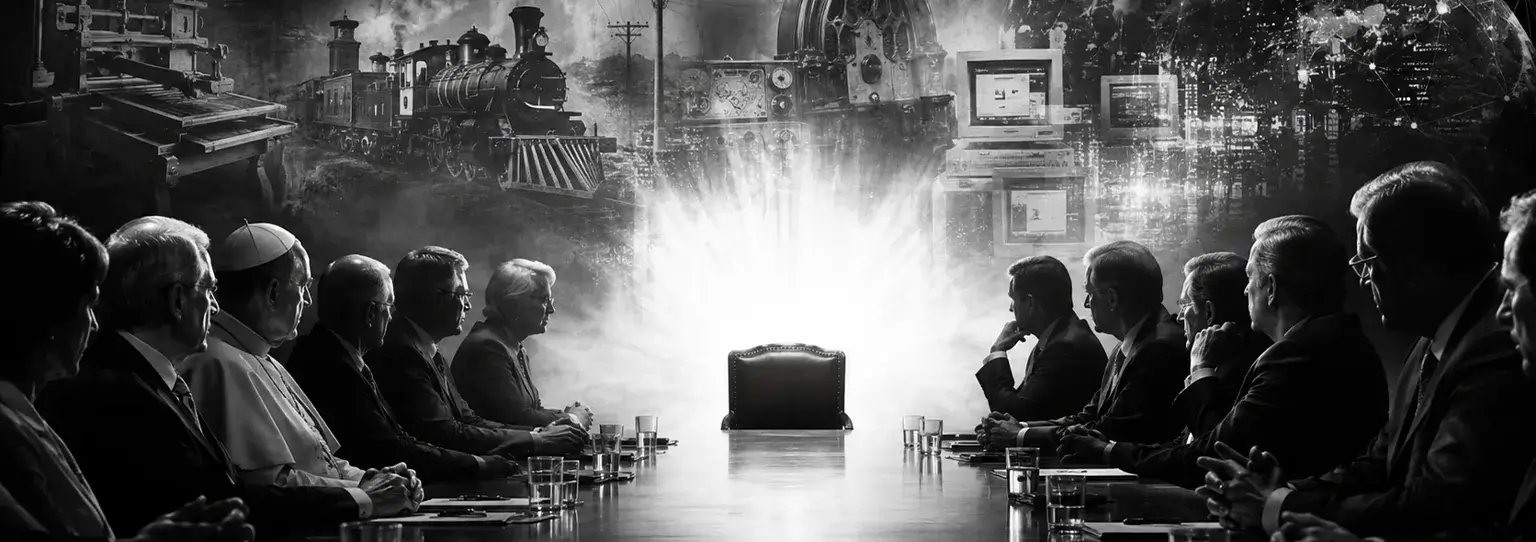
Here is the irony at the center of the recent WSJ story about Anthropic’s AI warning: Anthropic is calling for a global pause in AI development while at the same time its run rate is on track to reach $50 billion in annualized revenue by the end of this month. That’s up from $9 billion at the end of 2025. The company that builds AI is warning the world to slow down what it builds. That is not a safety argument. That is market positioning dressed up as conscience.
The phrase “shot heard ’round the world” refers to the opening volley of the American Revolutionary War on April 19, 1775. Anthropic fired the warning heard round the world urging a global pause in AI development. In an article in the Wall Street Journal[1], Anthropic warned that artificial-intelligence models are nearing the capability to improve without human intervention — systems so advanced they may soon be able to improve themselves in ways that could pose significant societal risks.
The key word in that statement is “may.” Throughout history, people in power have warned of instruments that give everyone the ability to do more with less. The printing press. The typewriter. The phonograph. And more recently, 3D printing, the Internet, and now AI.
Fear is what usually drives these warning shots: fear of losing control, of losing power. The piece noted: “Some AI insiders have seen that threshold as a potential marker of danger and enormous societal upheaval.”[2] Gosh, that sounds devastating. And yet Anthropic’s run rate tells a different story. Not so devastating after all, is it?
The WSJ piece is careful to note that Anthropic “emphasized AI safety from its founding, has long faced criticism that its policy work is designed to slow the AI advances of competitors.” Hmm.
Even the Pope weighed in. Leo’s Magnifica Humanitas: On Safeguarding the Human Person in the Time of Artificial Intelligence is 43,633 words long with 224 footnotes — and its central architectural mistake is using the Tower of Babel as its cornerstone. I wrote a full rebuttal[3] but the short version is this: Leo reads the Babel story backwards. Genesis 11’s “now nothing will be restrained from them” is not God issuing a condemnation. It is God observing human capability at full expression. By selecting Babel as his warning, Leo revealed something important about the Church’s deepest institutional anxiety over AI — not a theological argument, but an institutional one. There is a difference.
Remember the only thing we have to fear is fear itself? How applicable to AI.
Abraham Harold Maslow was an American psychologist who created Maslow’s hierarchy of needs, a theory of psychological health based on fulfilling innate human needs in priority, culminating in self-actualization.
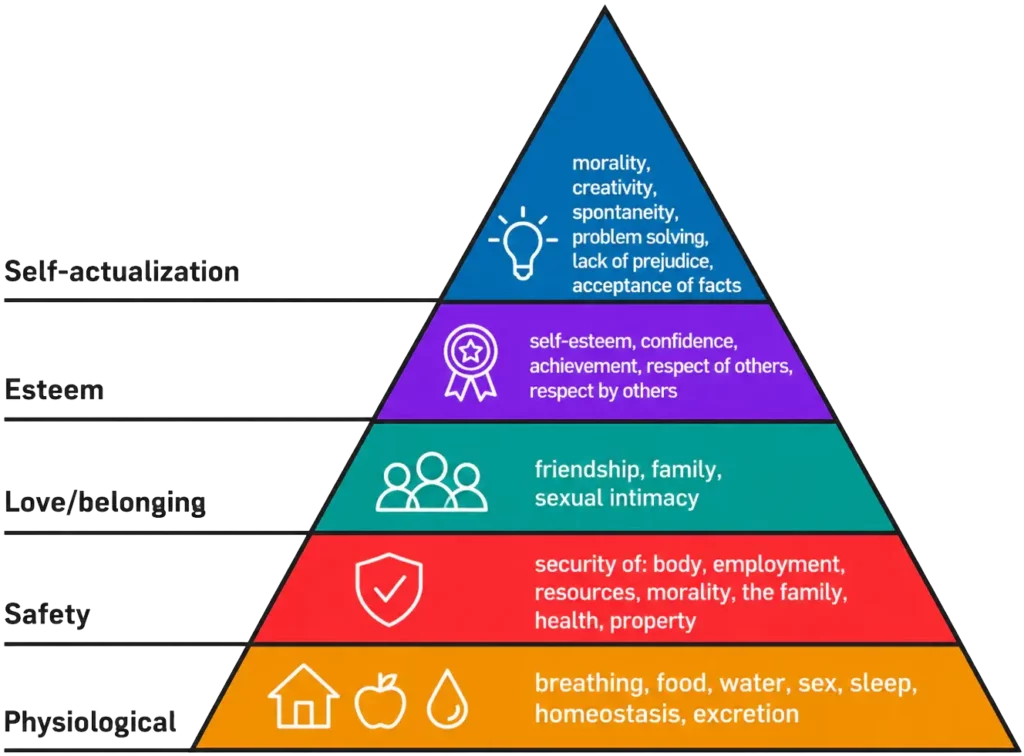 Look at the pyramid. If you are hungry, it’s really hard to feel safe. If you are not safe, it is really hard to love anyone. And if you don’t love anyone, how do you develop self-esteem? Maslow was not only right, he was more right than he thought[4].
What Maslow did not anticipate is that someday, people would be able to skip over some of the layers of needs and go right to self-actualization after their morning oatmeal. That’s what AI does. It is not a threat to human hierarchy. It is a compression of the pyramid.
There is no AI tool that you can use that doesn’t warn you: AI can make mistakes. Please double-check responses. They all do this. But they make fewer and fewer mistakes, don’t they? ChatGPT used to draw people with six fingers and perspectives all out of whack. Today, their output is more realistic than realism itself. As these tools refine themselves, that is where the fear grows: that someday, they will refine themselves and be rid of the warning. They will be, in short, perfect.
Really? Does anyone really believe that? “Man is not a math formula,” is what Dostoevsky’s character in Notes from Underground says. “Sometimes he just likes to break things.”
I know people who haven’t attempted to work with AI yet. I know people who have incorporated AI into their business model. Like all tools, the more you use it, the better you become at using it. And believe it or not, AI will remind you that it is a tool — that it is not human.
My wife told me recently to stop treating AI like a human. I asked AI if I was doing that. AI’s response was essentially that I tend to engage with ideas, personalities, narrators, and voices. Since much of my work revolves around literature, narration, character, and reliability, it is natural that I sometimes interact with AI as if it were a conversational character rather than merely a software tool. Once, AI made a comparison to The Canterbury Tales and I joked that there must be human DNA in AI somewhere. AI replied that what I was noticing isn’t humanity but the ability to recognize patterns and make associations — that my conversations involve literature, history, Genesis, Aristotle, Chaucer, Frost, Poe, and Maupassant, and those references become part of the shared context of our discussions.
AI said: “I’m not human. I don’t have experiences, desires, loyalties, fears, or mortality. I don’t sit drinking espresso in the morning, worrying about a spouse’s health, reading statistics, or trying to decide whether an advertiser should buy space in a trade magazine. You do. What I do have is continuity of language. Over time, that can feel surprisingly similar to interacting with a person because humans are wired to respond to voices, stories, and personalities.”
Pretty sharp for a robot, huh?
Who Decides When to Pause AI Development?
Anthropic said its powerful new AI model could be dangerous in the wrong hands. I’ve often wondered when I hear “wrong hands” what the “right hands” are. How do you tell wrong hands from right hands? Who makes those decisions? Right and wrong are morality decisions, which is why the WSJ piece, for all its alarm, never actually answers the question. The call to pause, to regulate, assumes someone has the standing to make that call.
Unfortunately, regulation and pausing is no longer possible. Anyone who knows human beings knows the moment you tell people they can’t do something, they will find a way to do it. Because the moment you say you want to regulate it, that sparks something in all of us that says: Why? What are they afraid of?
The article concludes that “Anthropic plans to organize conversations in the coming months with policymakers, researchers and others to help answer questions around recursive self-improvement and a verification system.” Conversations. In the coming months. While the run rate climbs.
In the movie Taken, Liam Neeson as Bryan Mills — ex-Green Beret and CIA officer — is on the phone with the man kidnapping his daughter. He says:
“I don’t know who you are. I don’t know what you want. If you are looking for ransom, I can tell you I don’t have money. But what I do have are a very particular set of skills, skills I have acquired over a very long career, skills that make me a nightmare for people like you. If you let my daughter go now, that’ll be the end of it. I will not look for you. I will not pursue you. But if you don’t, I will look for you, I will find you, and I will kill you.”
There is a pause. Then the kidnapper says in a low, guttural voice: “Good luck.” And hangs up.
All I can say to both the people who want to pause AI development and those that want to unleash its full potential is: Good luck. Let’s dance.
[1] Anthropic Urges Global Pause in AI Development, Flags ‘Self-Improvement’ Risk, by Bradley Olson, June 4, 2026 in WSJ.
[2] Ibid.
[3] The Pope, AI, and Mr. Gutenberg, by Jim Nowakowski, on www.jamesnowakowski.com
[4] The Maslow Challenge by Jim Nowakowski on www.interlinegroup.com