
Every year, major architecture firms publish forecasts identifying the forces reshaping the built environment. Gensler’s Design Forecast 2026 is one of the more thoughtful examples. It outlines six broad trends — experience, workplace transformation, agility, AI, adaptive reuse, and future-proofing — that are clearly influencing how buildings are conceived and delivered.
But trends don’t make decisions. Companies do.
And without strategy, trends don’t clarify choices — they compound them.
This matters for manufacturers because most trend conversations stop at observation. The conversations are actually monologues that describe what is changing, but rarely address the harder question: how should an organization respond to the changes — and what should it commit to when change itself is the only constant?
The answer is not flexibility for its own sake. The answer is actually alignment, which begins with a simple, unspoken truth:
Buildings are no longer neutral containers.
They behave (or have to behave in a specific way).
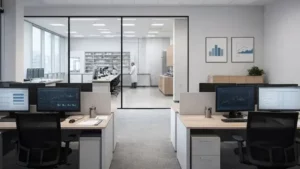 Organizations Have Personalities. Buildings Do Too.
Every organization has a personality, whether acknowledged or not. For example, sometimes these acknowledgements are in the company’s mission statement. But most of the time, you can “feel” the personality of the organization just by visiting it.
For some organizations, you feel they are analytical. Others you sense are operational discipline. Still others are collaborative by necessity; others by choice. And then there are others that seem to value speed; still others signal their reliability in their processes. These traits show up in your first encounter with the organization, and reveal themselves through how decisions are made, how risk is tolerated, and how people are managed.
What is less often stated — but increasingly obvious — is that buildings that these organizations inhabit have personalities as well. More important, the buildings often do NOT reflect the organization’s personality.
Not stylistic personalities. Operational ones.
Buildings impose rules, knowingly, or unknowingly. For example, use an organizations restrooms and it tells you immediately how much they care about hygiene. Walk into an elevator for a building and you begin to sense immediately the building’s “personality.”
Buildings privilege certain behaviors and suppress others. They reward predictability or improvisation. They reduce friction in some areas and introduce it in others. Over time, they shape how people act inside them far more powerfully than any policy statements or culture decks of the organization.
And understanding that buildings have a personality is where a manufacturer’s strategy should start — and where many organizations make a quiet mistake.
Too often, companies attempt to impose their personality on a building after the fact: retrofitting systems, layering features, compensating for misalignment. The more effective move would have been earlier and more disciplined:
That is, select a building whose governing logic already matches your own.
A research-driven organization, for example, should not ask how to make a building “more analytical.” It should ask whether the building already enforces analytical behaviors. According to Gensler’s own work across financial services, professional services, R&D, and industrial facilities, such structures tend to share common traits:
- Environmental stability rather than expressiveness
- Clear zoning hierarchies that separate focus, collaboration, and recovery
- Low noise floors and predictable thermal performance
- Instrumented systems that make performance visible and measurable
- Circulation and infrastructure that reduce cognitive friction
None of these are aesthetic choices. They are behavioral ones.
And they reveal a larger, important truth that is often glossed over in trend language: flexibility does not mean permissiveness.
Every functioning system — organizational or physical — requires a governing rule. Business is not a democracy. Neither is architecture. A building must have a dominant logic that outweighs individual preference, or it collapses under the weight of human complexity.
Sometimes, the correct response is not to bend the building to the individual — but to bend the individual to the building.
Which way to bend is not entirely the responsibility of design. But it is always the responsibility of the organization’s strategy.
 You’re Not Selling Products. You’re Supplying Personality Traits.
For decades, manufacturers have described their products in the language of enablement.
- HVAC systems enable comfort.
- Plumbing systems enable hygiene.
- Kitchens enable collaboration.
- Industrial systems enable efficiency.
While that language is not wrong —it is incomplete. In today’s environment, being incomplete is not acceptable.
Because what these systems actually do is not merely enable behavior. They enforce behaviors.
A building’s personality does not emerge from branding statements or design intent. It emerges from repeated interaction — from what the building allows easily, what it resists quietly, and what it makes impossible altogether. That is where the systems and products of manufacturers matter most.
Consider hygiene.
For decades, the industry has spoken about “supporting” or “encouraging” hygienic behavior. In reality, modern buildings do something far more decisive. Touchless fixtures eliminate alternatives. Temperature control removes variability. Flow rates discipline use. The behavior is not suggested; it is structured. On purpose. And that purposefulness is the characteristic of the building’s personality.
The same is true across categories:
- Quiet, stable HVAC systems do not invite focus — they remove distractions.
- Tight thermal control does not signal calm — it produces it.
- Redundancy does not communicate reliability — it guarantees it.
- Modular systems do not suggest adaptability — they make change survivable.
These are not neutral features. They are behavioral instruments.
And this is where manufacturer strategy becomes inseparable from building strategy.
Every building has a governing rule — safety, reliability, focus, throughput, resilience, hospitality, control. That rule sits above individual preference; it is the cloud from which everything else emanates. The rule determines how tradeoffs are resolved when systems conflict, budgets tighten, or conditions change. And the rule is embedded in the structure of the building’s personality itself AND the choices of products and systems it puts into itself.
Manufacturers participate in that hierarchy whether they acknowledge it or not.
A product can either reinforce the building’s governing rule — or quietly undermine it. Consider these examples.
An HVAC system optimized for peak efficiency but prone to acoustic drift erodes focus in an analytical environment. A plumbing solution that prioritizes choice over consistency introduces friction where predictability is the priority. A kitchen system designed for maximum flexibility may weaken operational discipline in an organization that depends on routine and control.
None of these failures are technical. They are strategic misalignments.
This is why the familiar claim — “our product supports experience” — is no longer strong enough. Experience is not a layer added after the fact. It is the cumulative result of enforced behaviors over time.
For example, when handwashing came into vogue even prior to covid, measurements of the act of handwashing itself came under scrutiny by unions. “We don’t need to be monitored,” was the outcry. So manufacturers added (unsuccessfully) timing software to distribute soap and water for the act itself. These “solutions” solved nothing: human behavior – and the fear of Covid – brought people to an awareness for true behavioral change.
Forward to today, and people have relapsed into compliancy and conveniently forget the importance of this simple act.
Manufacturers, whether they intend to or not, should be shaping such behaviors.
Which leads to the uncomfortable but unavoidable conclusion: Manufacturers are not supplying components.
Manufacturers are supplying traits that either strengthen or weaken the building’s personality.
Tenants – like the cells in all of us – are the blood of a building. Blood can be healthy or diseased. What makes blood healthy or diseased is how you feed it – the structure of your body itself.
And because buildings are now expected to absorb volatility — regulatory, climatic, operational, economic — such traits carry long-term consequences to the personality and health of the building. In a world where change is constant, inconsistency – as in real life — is risk.
This is why strategy now matters more than features. Not because features are irrelevant, but because without strategic alignment, features will work against each other.
 Flexibility Without Hierarchy Is Not Adaptability — It’s Risk.
“Flexibility” has become one of the most overused — and least examined — words in discussions about the built environment. In Gensler’s forecast, flexibility appears everywhere: flexible workplaces, adaptable reuse, reconfigurable systems, buildings designed to evolve over time.
The observation is correct. The conclusion many draw from it, is not.
Flexibility is often treated as an end in itself, as if the ability to change automatically produces resilience. In reality, change without hierarchy produces instability, not strength.
A building designed to absorb uncertainty still requires a governing rule. In fact, the more uncertain the environment, the more important that rule becomes.
This is where many well-intentioned “open” environments fail — not because people resist collaboration or adaptability, but because the system lacks a clear priority when competing demands collide. Noise competes with signal. Choice competes with consistency. Efficiency competes with comfort. Sustainability competes with redundancy.
When everything is flexible, nothing is decisive.
Gensler’s own work quietly acknowledges this fact, even if the trend language remains optimistic. Across professional services, financial institutions, industrial facilities, and critical infrastructure, successful projects do not offer unlimited choice. They establish dominant conditions and allow flexibility only within those boundaries – the governing rule.
- Focus-first environments tolerate collaboration — but not noise.
- Reliability-first environments tolerate customization — but not variability.
- Resilience-first environments tolerate redundancy — but not fragility.
Adaptability, in other words, is not freedom. It is controlled change.
This is where artificial intelligence and digital modeling enter the picture — not as creative replacements, but as tools of discipline.
When Gensler describes digital twins, AI-enabled modeling, and data-driven design intelligence, the real promise is not speed or novelty. It is foresight. These tools allow designers and operators to test decisions before they harden into physical reality. They reveal which traits reinforce the building’s governing rule — and which quietly erode it over time.
A digital twin does not democratize decision-making. It clarifies it.
By modeling thermal drift, occupancy patterns, energy demand, acoustic behavior, and maintenance cycles, these systems expose tradeoffs early — when strategy can still intervene. They do not eliminate judgment; they sharpen it.
For manufacturers, this shift is huge.
Products are no longer evaluated only on peak performance or compliance at installation. They are evaluated on how they behave across scenarios: growth, contraction, repurposing, regulation, climate stress, and operational change. A component that performs brilliantly in isolation but poorly in combination introduces risk into an environment that is explicitly designed to manage it.
This is why flexibility without governance will fail — and why strategy must precede all specification.
Buildings that endure are not endlessly adaptable. They are strategically constrained to their governing principle. They change along intended paths of that principle, resist change where it introduces risk against that principle, and enforce consistency where trust depends on its enforcement.
In such an environment, the manufacturer’s role is no longer peripheral. It is structural.
Manufacturers are, therefore, not responding (and should not respond) to trends. Manufacturers should be participating in a system designed to make the right decisions under uncertainty.
So the question products now have to answer — whether stated or not — is simple:
Do your products strengthen the rule that governs the building, or do you undermine it when conditions change?
Strategy Is What Makes a Building Coherent Over Time.
Gensler’s forecast is often read as a document about design. In practice, it is a document about decision-making under uncertainty.
Experience, flexibility, AI, adaptive reuse, and resilience are not independent trends. They are symptoms of a deeper condition: that organizations no longer operate in stable environments. How many buildings are still standing from 30 years ago and functioning the same way? From 40 years ago? From 10 years?
Regulatory pressure, climate risk, labor volatility, technological acceleration, and capital constraints are now permanent features of the landscape and demand flexibility. But without that governing principle of the building’s personality, nothing really works, does it?
Buildings are being asked to absorb that uncertainty — not once, but continuously.
That is why coherence matters more than novelty. Purpose matters more than aesthetics.
A building that changes easily but inconsistently erodes trust. A building that offers choice without hierarchy confuses behavior. A building that optimizes for every condition simultaneously fails under real-world pressure.
The buildings that endure are not the most flexible ones.
They are the most strategically governed.
And understanding that point is where manufacturers either gain relevance, or lose it.
Because once buildings are understood as governed systems — not neutral containers — product decisions are no longer technical preferences. They are strategic commitments. Every system introduced into the building either reinforces the governing rule or weakens it when conditions change.
That is the true test — the distinction most manufacturers have not yet fully confronted.
For decades, success was measured by performance at installation: efficiency, compliance, cost, specification wins. Today, success is measured by performance over time — across uncertainty. How a product behaves when occupancy shifts, when regulations tighten, when spaces are repurposed, when energy prices spike, when expectations change.
This is why differentiation can no longer rest solely on features.
Features can be copied.
Claims can be matched.
Compliance can be met.
What cannot be easily replicated is a strategic fit.
Manufacturers who understand the governing rule of the environments they serve — analytical, operational, resilient, collaborative, controlled — can design and position products that strengthen those systems rather than strain them. They move from being component suppliers to being structural partners in decision-making.
This is the real implication of Gensler’s work for manufacturers:
Manufacturers are not reacting to trends.
Manufacturers are helping organizations remain coherent as conditions change.
And in a world where uncertainty is no longer episodic but constant, coherence is the most valuable trait a building — and a supplier — can offer.