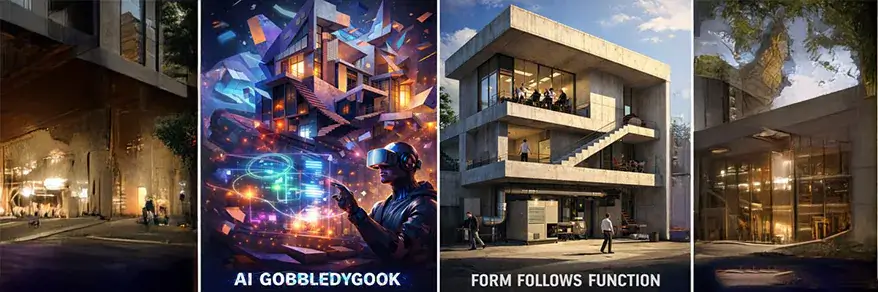
How the Language of Design Drifted Away from Design (and Why AI Makes It Worse)
There are good stories, and then there are classics.
A classic is not just a story that entertains. It is language charged with meaning. It shows us how others lived — and in doing so, it teaches us something about how we live, and how we might live better. Classics make us better readers of life itself. They refine judgment. They tell the truth in a way that lingers.
And then there’s Jack Reacher. Efficient. Formulaic. Always moving. Well-written in its own way. But made to be consumed and forgotten.
This matters because in the built environment — and especially in the way some architects talk about it — we’ve begun to confuse these two categories.
We’ve started treating design as if it were storytelling.
And we’ve started using language not to clarify reality, but to decorate it.
The Great Problem: Words Fall Short
Architecture is one of the most difficult human achievements to describe. Unfortunately, words are poor substitutes for what our eyes tell us.
Besides, a building isn’t experienced the way a painting is experienced. You don’t “view” a building; you inhabit it. You move through it. You hear it. You feel temperature drift in it. You notice the silence — or you notice the noise. Your senses are completely responsible for comfort, anxiety, calm, compression, distance, isolation, friction, relief.
How do you use words to describe all that? No sentence fully captures it. No paragraph fully explains it.
Words fall short. They always have.
And therein lies the problem: when words fall short, they create a serious gap between experience and explanation.
And gaps in human communication always attract opportunists.
They attract people who use abstraction as camouflage. They attract people who tout significance rather than produce meaning. They attract people who can speak in a way that sounds important while committing to nothing measurable.
That is the danger.
When language cannot fully represent experience, nonsense learns how to hide inside it.
Not in the form of lies — but in the form of ungoverned language.
The Drift: When Design Became “Storytelling”
In recent years, a certain kind of architectural language has become fashionable:
Design “evokes emotion.”
Buildings “set the stage for the stories we live.”
Spaces have “emotional cores.”
The built environment is “a narrative.”
All of it sounds plausible. All of it sounds elevated. Yet all of it risks becoming a substitute for something harder:
What does the building actually do?
Because if design is truly about human behavior — not just appearances — then we must be willing to say what the building enforces.
Not just what it expresses.
A building does not merely evoke.
A building disciplines.
A building privileges certain behaviors and suppresses others. It rewards predictability or improvisation. It reduces friction in some areas and introduces friction in others. It changes what is easy, what is hard, what is possible, and what is impossible.
That is not storytelling. That is governance.
And that’s why the best and worst design are the ones you don’t notice — but your feelings do. One way or the other.
A building is not a poem. It is a system.
And the point of systems isn’t beauty. The point of systems is control under complexity.
Yes, beauty matters. Emotion matters. But emotion in architecture is often the byproduct of systems doing their job so well that we stop noticing the strain — until the strain returns.
When an HVAC system is quiet enough, focus becomes possible.
When plumbing is touchless, hygiene becomes habitual.
When circulation is intelligible, stress is reduced.
When zoning is coherent, behavior stabilizes.
A building makes rules real.
The Hiding Place: Abstraction Without Accountability
This is why the drift in architectural language matters.
When a person says a building is “setting the scene for the stories we live,” the question isn’t whether that sounds inspiring.
The question is:
What does that mean operationally?
What behavior is being encouraged?
What behavior is being resisted?
What tradeoff is being made?
What friction is being accepted?
What hierarchy governs the collision of demands?
Because this is where reality always arrives: conflict.
Noise competes with collaboration.
Efficiency competes with comfort.
Flexibility competes with consistency.
Customization competes with maintainability.
Resilience competes with budget.
Real buildings are not made of rhetoric. They are made of tradeoffs.
A sentence that cannot cash out into a tradeoff is not insight. It is theater.
Enter AI: The Factory of Gobbledygook
Now we arrive at the new hero of the story: artificial intelligence.
We are told AI is transforming design communication. That it helps designers visualize and iterate. That it makes “storytelling” more vivid. That it allows us to imagine “human experience” before a space is built.
But pause for a moment:
Isn’t imagining experience and communicating it the job of the architect?
If AI is now being celebrated for doing what professionals claim is central to their expertise, then we are admitting one of two things:
Either architects weren’t doing that job very well —
Or AI is being used to perform the job instead of the architect.
This is where the rhetoric becomes suspicious.
We are also told AI is not here to replace creativity — it’s here to “amplify” it.
Amplify.
A word chosen very carefully because it implies:
More power.
More intensity.
More significance.
Without loss.
But creativity is not a volume knob.
If AI does anything, it increases output. It accelerates variation. It lowers the cost of generating options. It makes iteration faster.
That’s the speed claim — and it’s believable.
But substance?
Substance is not speed. Substance is not iteration. Substance is not aesthetic realism. Substance is not vividness.
Substance is judgment.
Substance is hierarchy.
Substance is constraint.
Substance is knowing what must not change when everything else is changing.
AI does not provide that. Architecture does.
In fact, AI makes it easier to avoid it.
Because AI is very good at producing language that feels finished — language that sounds thoughtful, balanced, elevated, and plausible — without requiring any governing rule underneath it.
AI is not merely a tool for design. It is a tool for rhetoric.
And rhetoric without governance becomes… gobbledygook.
Gobbledygook is language that sounds profound but cannot be made operational.
The Real Danger: Persuasion Without Truth
Here is the uncomfortable truth no one wants to say:
AI doesn’t just accelerate design output.
It accelerates persuasive artifacts.
It makes it possible to generate beautiful visuals and coherent narratives so quickly that people mistake the artifact for the decision.
But artifacts are not decisions.
An image is not a plan.
A narrative is not a performance model.
A “story” is not a thermal load calculation.
A “vivid experience” is not a maintenance cycle.
We are entering an era where it becomes easier than ever to sell certainty.
And that certainty will often be false — because it is produced by persuasion rather than by tradeoff discipline.
AI makes it possible to generate confidence at scale.
That is not a design transformation.
It is a risk transformation.
This is Jack Reacher language: fluent, fast, and forgettable. And in architecture, forgettable language produces expensive consequences.
What a Building Is For
So what is a building for — really?
Not to “tell stories.”
Not to “set scenes.”
Not to provide “emotional cores.”
A building is for:
Enforcing behavior under complexity.
Reducing friction in the routines of life.
Surviving change without losing coherence.
Absorbing uncertainty while protecting human purpose.
In other words:
A building is for governing.
And governance requires a ruling.
It requires hierarchy.
It requires constraints strong enough to withstand human complexity, competing demands, and the temptation to please everyone.
Which is why the language of design must become more accountable, not more lyrical.
When architects speak like poets, they may sound important — but buildings are not built out of significance.
They are built out of decisions.
And decisions demand clarity.
AI will not save design from that burden.
It will only make it easier to hide from it.